920x60-2

Archive for the ‘Food Storage’Category

Article Contest Entry – Sound Advice

Thanks to Teresa for today’s entry into our Food Storage Article Contest!  I definitely relate to what she recommends; I did my ‘Buy-one-get-one’ day at Publix yesterday and got a cartful.  I don’t have any broth to speak of, but I’ll keep watch around turkey day this year!=)  Time is getting short so get your entries in; we’ll do the giveaway the weekend of July 15! 

     One piece of advice I have about food storage is to store even amounts of food in each 5 gallon bucket. For example, instead of storing one bucket of rice, one bucket of beans, one bucket with baking ingredients- put one or a few of each in every bucket. Of course you would probably want each item in a separate Mylar bag. This way each bucket contains a variety of items and you don’t have to open multiple buckets to get things you need during an emergency situation. I also developed a labeling system so that I know exactly what is in each bucket and the date it was packed. Obviously the date is very important so you can rotate your buckets accordingly.

Advice & Beans gives very good advice about buying an extra can item or bag of beans each time you go to the store. This helps those of us who cannot afford to buy everything at once. I always watch the store advertisements and when something I always use goes on sale, I buy quite a few of them. For example, canned chicken broth always gets down to .29 cents around Thanksgiving. I tend to try and store lots of it, partly because it works great in rice instead of water. That can come in handy if you’re trying to conserve as much water as possible during a crisis situation- plus it adds flavor.

 When thinking about long-term food storage, water is something many of us forget about yet it is the most important necessity for our survival. If you ever get in a situation where there is no running water, and you run out of stored water- remember there is usually 20-50 gallons in your hot water heater tank. It also would not be a bad idea if you kept some water purifier tablets on hand in case you had to get water from another source such as a lake or river. Good luck and happy storing!

21

06 2011

The Right Stuff – Be Prepared!

A good bunch of information, provided via NASA’s new emergency preparedness push.  Now if only every federal, state and local municipality made it a similar priority, we’d be getting somewhere!  Though, of course, it always comes down to each of us, as individuals and family members, doing what we know is right in order to be able to protect our own and attempting to not be a burden on the system should a disaster occur.

18

06 2011

MOLT: The Enemies of Long Term Food Storage

One of the most frequent questions I get asked is how long food will store if using Mylar Bags and Oxygen Absorbers.  I don’t try to be evasive, but sometimes I can’t come right out and say a specific period of time, whether that will be 1, 5, 10, 20 or even 30 years, which is the claim that many survival and preparedness sites use as the longest food will store.  The reason is that there are multiple factors that go into whether your food will store poorly or well long term, and the packaging is just one piece of it.  I definitely don’t want my families livelihood or another families survival threatened if I say ‘yes, your food will store 5 years’ and then 5 years from now someone opens their food and find it is spoiled because they stored it in their garage which is 110 degrees in the summer and -10 in the winter, they didn’t seal the bags properly, and they stored food with 25% moisture content.

Here is what I will say:  there have been studies of food storage methods done by the LDS and others that indicate some foods can be stored up to 30 years or more.  What that means is that the food retains its nutritional and caloric value, but might still have some taste and palatability issues.  However, please be aware that most of these studies are for the standard practice of the LDS Church of using #10 cans in their food storage.  You might find it funny for a supplier of Mylar and O2 absorbers to recommend #10 can sealing.  Mostly I want to provide the best information I can, and there is no doubt that #10 can sealing is the best way to store food long term…if you have access to a sealer and a supply of #10 cans.  The challenge is can sealing is VERY expensive.  To store the same 400 pounds of food that a standard Mylar Bag combo kit can, it would take approximately 80 #10 cans.  Even if you add in the cost of buckets, it would cost the average person $80.00 or so to store using Mylar and buckets, but over $400 using #10 cans.  That’s a pretty huge difference if you are trying to take care of your financial resources.  If you have access to an LDS cannery, you can get cans much cheaper, but even so it would cost 50-100% more to store using cans.

So yes, I recommend #10 can sealing if you can afford it and have access to the tools needed, but I recommend Mylar and bucket storage as the next best thing for the rest of us.  A properly sealed Mylar bag stored with an oxygen absorber inside a bucket mimics the most important properties of the #10 can system:  oxygen elimination and light control inside a rigid barrier to protect from rodents or insects.  The other two properties that most effect your long-term food storage and temperature and moisture. 

Because I had a hard time remembering the four main enemies of food storage, I came up with the acronym MOLT.  It stands for Moisture, Oxygen, Light and Temperature, and it helps me keep focused on mitigating each of them when our family stores food.  Sometimes I include ‘Time’ as a fifth enemy, but it is really just that the other 4 do damage…over time.  Let’s take a brief look at each.

Moisture is probably the most difficult of the factors affecting your food storage, mainly because it is a byproduct of our environment and where we live, as well as a component of the actual food.  Unless you live in a desert or extremely arid part of the country, you are going to have some or much humidity at one or more points during the year.  This is also why you should look to store low moisture foods, preferably under 10%.  It’s interesting that many types of dog food will list the moisture content right on the bag (we have several between 8-12% moisture stored), but people food generally won’t.  This is likely a combination of lack of interest, lack of regulation, and the fact that people foods are almost always listed with a shelf life.  The food types that are available with a low moisture content are those people generally associate with long-term food storage:  grains, beans, legumes, and dehydrated or freeze dried foods.  If you are buying bulk grain from a farmer, they will usually know the moisture content of their products; some bulk packaged foods at the big box stores may also indicate it on their packaging.  A good rule of thumb is grains will shatter and turn to powder if hit with a hard object; other seeds should break in half if bent.  This is another case of using your best judgment.

The second enemy of food storage is oxygen.  Oxygen allows the growth of micro-organisms, some of which can be harmful to food, as well as causing oxidation (especially profound on oils, which become rancid) and spoilage.  Luckily, with the development of oxygen absorbers, it has become fairly easy to eliminate oxygen inside food packaging.  Mylar bags meant for food storage have incredibly low oxygen (and water vapor) pass through.  For example, the larger Mylar bags we carry have an Oxygen Transfer Rate (OTR) of less than 1cc (1/1000th of a liter) per year.  So if you stored a bag of wheat long-term and it was properly sealed with an oxygen absorber, it would take 1000 years to have 1 liter of oxygen pass through the bag.  That’s quite a barrier!

Light is the third enemy of food storage.  This, combined with the others,  is why it is always recommended that you store food in a ‘cool, dark, and dry’ place.  Like oxygen, light causes spoilage and the reduction in vitamin content in food.  However, it is probably the easiest characteristic to guard against.  Mylar itself is an excellent light barrier; a bucket is another.  Storing food in a dark area completes the process.  Even most standard food packaging blocks light sufficiently.  I suggest this is probably the easiest of the 4 enemies to fight.

The final enemy of food storage is temperature.  Depending on where and how you live, it may be easy or extremely difficult to control the temperature at which you keep your food storage foods.  In the old days, many people had root cellars to help preserve food.  Today, if you have a basement, it may stay relatively cool as well.  We are lucky in that we have a split-level ranch where our downstairs/basement stays on average 10 degrees cooler than upstairs.  This allows our food storage to stay in relatively decent condition of around 50-60 degrees year-round.  However, during the height of summer it can get to 70 degrees, depending on how much we use our basement door for outside access.  One rule of thumb is that for every 10 degrees warmer it gets, your foods’ shelf-life is cut in half.  For example, if you go from storing a bucket of wheat at 60 degrees to 70 degrees, instead of lasting 20 years, it will likely only last 10.  You can see how important this makes the environment you are storing your food in.  I’ve seen some great suggestions for storing food in a regular living area to take advantage of the generally cooler environment.  For example, some folks store food in closets or under their beds.  You can find wheeled shelving that will even let you put canned goods under a bed and be able to roll it in and out for access.

As you examine your situation, take some time to plan when you are about to begin a phase of food storage.  Understand the environment you have to work with, and consider buying foods appropriate to that environment.  If you live in area where humidity is high year-round, consider more canned goods than others which will degrade because of that.  If temperature is an issue, be prepared to rotate your foods more frequently.

As always, if you have any questions, please drop me a line at admin@adviceandbeans.com!

14

06 2011

Article Contest Entry – Just Do It

Thanks to Tessie from the beautiful (but expensive!) Aloha State for today’s entry into our Food Storage Article Contest.  Folks like her are the reason I started this blog and business, and her entry provided a boost of motivation at a time when I’m still a little worried about not having a ‘day job’.:

There are many reasons why people don’t start or keep up a food storage program.  No money, no space, no time, no know-how.  I identify with this very well: these have been my excuses (um, reasons) for not doing everything I could to protect my family’s future.  But here’s what I tell myself these days: just do it and don’t give up!

I live in an area where there’s no Costco, LDS center, or anything vaguely resembling either icons of food storage.  Wal-Mart is a day-trip away and involves the use of not one but two modes of transportation that add at least $100 to the bill.  Our local stores’ sales are more than what most of the country pays at full price: there is never a “loss leader” product, never a double-coupon day.  There are no establishments here that will give me food-grade buckets or even sell me buckets.  My husband lost his job a little while ago and we’re raising our small children in a one-bedroom extension.

I sigh a little each time I read about buying $1000 worth of groceries for $46.23 or see photos of well-appointed household pantries.  However, what’s true for me is true for the person with an unlimited budget and space galore: you can never be sure it’s enough.  If I keep at it, I have just as much chance of making it through a crisis as Mr. Moneybags.  Just do it and don’t give up!

Educate yourself for free online.  If you don’t have a computer, most local libraries have free computer services.  The internet offers a wealth of information for the easily-overwhelmed and shallow-pocketed like me: how to work with a limited budget, reaching simple goals, finding space you never knew existed, alternatives to common storage practices, the best online stores and even regionally-adapted guidance.  Not much time?  Subscribe to email newsletters, Twitter or RSS feeds.  Absorb advice from wherever you can but balance it by doing your research and by evaluating what works best for you in YOUR situation.

If nothing else, make time to evaluate your budget.  I actually found more money to use for food after my husband’s layoff than before it because I was forced to actively look at where our money was going.  A few dollars trimmed here and there adds up.

There is no down side to storing food: it will serve you in ANY personal situation, will not depreciate in value and, despite not knowing whether it will be enough in an emergency, gives you peace of mind knowing that you are at least better off than when you were giving excuses (sorry, reasons) about why you couldn’t begin.

I’m struggling to achieve my goals on a shoestring budget from the nether reaches of the good ‘ole U.S.A., but I’m getting there.  So will you:  there really isn’t any reason why you shouldn’t start or keep up with a food storage program.  Do it.  Don’t give up.

25

05 2011

Article Contest Entry: Copy Canning 101

Thanks to Laura from MO for this sound advice!  Anyone interested in entering the contest just drop me a line!

I first heard the term “copy canning” in 2000 or so, just after the Y2K computer crash never happened. It orginates as far as I can tell with an article by Karen Hood (her and her husband are pretty famous in the survivalist community).  I’ve never read it on this blog, though what the owner advocates is basically the same thing.  I guess common sense is common sense. 

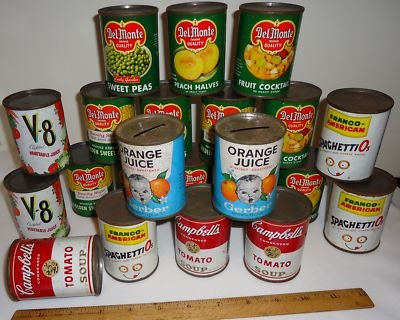
The biggest question I get from my non-prepper friends and family is “How do I start?  I’ll never be able to afford a years worth of food”.  Well, other than “are you crazy?”  Copy canning has become my easy answer and a way to introduce people to food storage without the buckets and mylar (no offense) or the crazy-expensive freeze-dried or dehydrated foods.  I simply tell people:  buy what you regularly do, just buy a little extra.  It works best with canned goods, but it certainly works with almost anything you might regularly buy, except for perishables such as fresh fruit and vegetables or meat. 

Inevitably, copy canning becomes addictive.  I’ll hear a friend say “The fruit salad was on sale and we’re going to eat it anyway so I bought 10.”  Usually followed by “Do you have any extra space at your house?”  So the next step in the process is to teach people how to start organizing it and understanding how much food they actually have on hand and setting a goal of how much they want.  If a family eats 45 cans of vegetables per month and they now have 120 in the basement and 15 more in the pantry, they have 90 days of vegetables on-hand.  That doesn’t necessarily equate to 90 days of food, just 90 days of that particular item they regularly eat. 

So my advice?  Follow a few simple steps, and then a few more, and you will be more prepared than 80% of people in the world.

1)  Start copy canning today – buy 1 extra item of any item you buy when you go grocery shopping, except for perishables.  You can set a goal of how much food you want on hand later, the important thing is to actually start!

2)  Keep your ‘extra’ cans separate – Don’t put them in the pantry with the rest of the food.  Why?  Because if you do, you will likely eat it all before you buy any more, counteracting what you want to accomplish.  Many people buy racks to store food, but I’ve seen some with limited space store flats of cans under beds, in closets, and in their garage.  My suggestion is if you have to store in the garage, rotate your food more often, because the temperature extremes will lower the shelf life.

3)  Rotate your food – If you eat a can of beans, add it to your grocery list, go get one from your storage area to replace in your pantry, and buy it when you next go shopping.

That’s really all there is too it.  I sometimes laugh when I see hundreds of blogs and websites about food storage, when all it really takes is some common sense.